One thing is for certain, and that is there are few teachers around who aren’t feeling like they’ve run a couple back-to-ultra marathons these days. After the September to November sprint of start-up, meet the teacher, diagnostic assessments, long-range planning, new testing initiatives, re-organization, getting to know the parents, meeting the needs of the kids, IEPs, progress reports,....do I need to go on?
It’s kind of incredible that we get through it, to be honest. Many of us are just treading water. Some of us are feeling like we’ve got just a nostril above the surface to breathe, and others are wondering if we might just drown.
Stop. Take a breath. Hold it. Breathe out. And reflect.
These struggles need not be handled on one's own.
I can empathize. I am a teacher. I teach and offer therapy too. (OCT # 575516 )
Teacher Tired... (many just don't understand)
SIX weeks of therapy over the summer to help rebuild the foundation you once had.
Use the summer to rewrite the teacher you are.
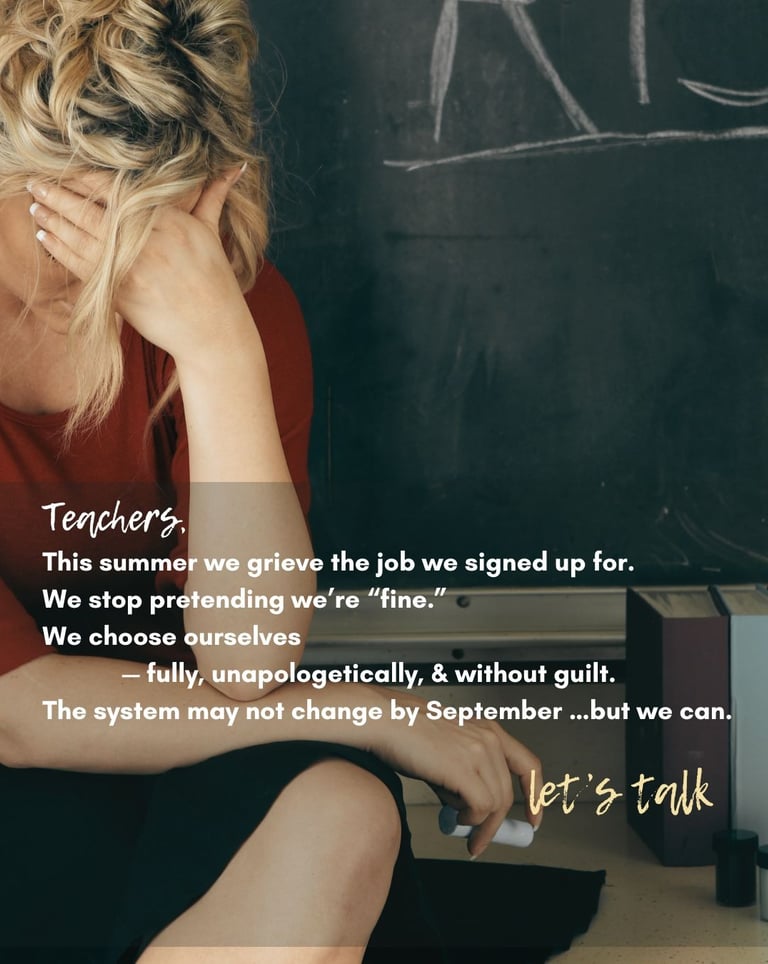
The system may not change by September …but we can.
SESSION TOPICS
Grieving the Job You Signed Up For
Core idea: Teaching changed after COVID.
We didn’t consent to the new version.
Before healing, we must name the grief.
Understanding Your Nervous System
Core idea: Burnout isn’t a mindset problem
— it’s a physiological one.
Rebuilding Boundaries
Core idea: Teachers weren’t allowed boundaries for years.
Rebuilding them is an act of recovery.
Reclaiming Your Identity
Core idea: You are not your job.
You are not your students’ emotional sponge.
You are not the system’s shock absorber.
Adapting to the Reality (Not the Fantasy) of Teaching
Core idea: The system isn’t changing fast.
But you can change how you relate to it.
Rewriting Your Foundation for Fall
Core idea: You don’t need to dread September.
You can build a foundation that protects your body, your time, and your identity.
Overwhelm often shows up long before someone realizes they’re struggling. It’s not just “being busy”—it’s a state where the mind and body start signalling that the load has become too heavy to carry alone.
What overwhelm can look like
Constant mental noise where even small decisions feel hard because your brain is already running at capacity.
Emotional fatigue that makes you more irritable, tearful, or numb than usual.
Difficulty concentrating or retaining information, even when you’re trying your best.
A sense of falling behind no matter how much effort you put in, creating a cycle of self‑criticism and pressure.
Physical symptoms like headaches, tension, disrupted sleep, or feeling wired and exhausted at the same time.
Avoidance or procrastination not from laziness, but because your system is overloaded and trying to protect itself.
Losing your sense of self as responsibilities pile up and there’s no space left for rest, joy, or identity outside of performance.
Why it matters
Overwhelm is a sign that your internal resources are being stretched by external demands—deadlines, expectations, perfectionism, or systemic pressures that don’t leave room for being human. It’s not a personal failure; it’s a nervous system response to chronic stress.
How support helps
Therapy creates space to slow down, understand what’s driving the overwhelm, and rebuild sustainable ways of working, learning, and caring for yourself. It helps you reconnect with your values, set boundaries, and move from survival mode back into a life that feels grounded and manageable.
Many people face many unique stressors these days, and finding a therapist who can connect with them can be tricky. Working with children and teens is an area of expertise for me, as I have successfully built effective and lasting strategies for connecting with this group over the last 30 years.
I understand school stressors and have supported students with school avoidance, school-related traumas, learning challenges, and many other problems impacting our kids' lives. I am so familiar with the stressors that can bubble up as kids move into new friend groups or are pushed away from peers. I have supported teens through many of the trials that Covid brought and the aftermath of how it has changed teens' normalcy. I have helped families adapt to learning challenges within school systems and then guided through focusing support structures at home.
From kindergarten to teens. I can always do a complementary consultation just to answer any questions you might have.
No pressure at all.
Student Stress
“Your body hears everything your mind says.”
– Naomi Judd
Summer Teacher Re-Set
Overwhelm. What does that look like?



let's talk ~ nina
You didn’t come this far to stop
Email: nina@livingroomwellness..com
If you are in crisis or need immediate assistance.
Canada's Suicide Crisis Helpline 9-8-8
For Emergencies Call 9-1-1 or to your local ER
BREATHE - 1-800-917-0272 (Black victims and survivors of crime across Canada)
Kids Help Phone 1-800-668-6868
For Indigenous People across Canada - 1-855-242-3310
LivingRoomWellness is not a crisis service.
LivingRoom Wellness is situated upon the traditional territories of the Erie, Neutral, Huron-Wendat, Haudenosaunee, and Mississaugas. This land is covered by the Dish With One Spoon Wampum Belt Covenant, which was an agreement between the Haudenosaunee and Anishinaabek to share and care for the resources around the Great Lakes. This land is covered by the Between the Lakes Purchase, 1792, between the Crown and the Mississaugas of the Credit First Nation. The region is home to many Indigenous Peoples from across Turtle Island. I strive to do more and learn more about the rich history of this land so that I can better understand roles as a resident, neighbour, collaborater, and caretaker. Furthermore, this learning will deepen my understanding of my privileges as a settler on this territory.
Acknowledgement
LGBTQI2SA+ Safe Space